Cat Anatomy
A look inside how our fierce feline friends effectively move, hunt, and slurp.

By James Yang
What do you think about when you’re hungry? There isn’t too much you really have to do. Scamper over to your refrigerator and whip up a quick PB&J sandwich before heading back to your desk? Take a trip to McDonald’s to devour a Quarter Pounder after school, even though Mom’s making spaghetti later? Cats think about their next meal all the time—and they will literally kill for it.
Feline bodies have long since adapted to a hypercarnivore diet, meaning that they need to eat highly nutritious meat in order to survive. For example, cats have 28-to-30 teeth, but few molars to chew plants, so their dietary options are limited to meat. In the wild, this means that cats need to hunt with every means their bodies can possibly use. They rely on their sense of sight, touch, and hearing more than most animals.
“All modern cats, except cheetahs, have protractile claws, similar body shape and teeth, and vocalizations. The primary difference between modern cats is their exterior fur length and patterns,” according to NHM's Terrestrial Mammalogy Curator Kayce Bell and Mammalogy Collections Manager Shannen Robson.

Prey, Watch Out!
Since a cat’s eyes are at the front of its head, they can clearly focus on the area in front of them (binocular field of vision) and judge the distance between themselves and their prey. Feline pupils can also dilate three times larger than a human’s, which allows them to take in twice as much light, and the tapetum lucidum at the back of the cat’s eye reflects light in the dark, allowing for night vision abilities. It’s no wonder why lions typically hunt at night, when they can catch smaller daytime animals off guard!
All members of the Felidae family are covered in fur. Specialized hairs called vibrissae also grow on their bodies (known as whiskers, when on a cat’s face), however, and they are stiffer, thicker, and four-to five-times longer than fur. These hairs are extremely sensitive to the animals’ environment and enhance their sense of touch. Cats also use their whiskers in order to check if they are able to move forward, allowing them to sneak up on their prey or fit through tight spaces without a hitch.
A few species, like servals, have huge ears that can rotate by themselves. These cats are able to hear even the faintest of sounds coming from every direction, finding prey hidden in snow, tall grass, or underground. Even if they can’t see their food, they can still hear them!
Leaping and Landing
These detection abilities all build up to the grand finale of a kill—paws and hind legs move as one. Felines’ strong legs allow them to jump as high as 11 feet to cross long gaps or catch flying prey like birds or squirrels, while their curved keratin claws can fight, latch onto tall structures, or mark territory. Be careful, though; these sharp weapons are easily damaged, being made of the same material as human nails, so they can be retracted into the paw by an elastic ligament when they’re not in use.
Though cats jump very high, they have to land on the ground somehow. No matter how they jump, their inner ear and the vibrissae hairs on their bodies provide a cat information about its positioning in the air, which cats can use to twist themselves upright in a split second. The shock force from the impact is absorbed into soft pads on their paws, greatly reducing the danger of high leaps.
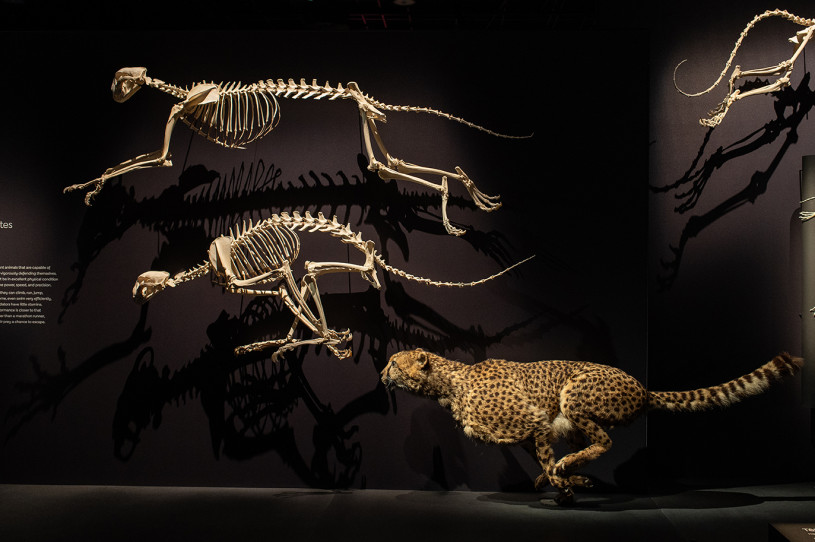
“Their streamlined body and long limbs, flexible spine, and "righting" reflex are all evolutionary selected traits for balance, speed, and stealth for precision hunting but also for escaping predators themselves,” Robson explained. “These features are so successful that once it evolved that there has been very little selection for additional diversity in this group since then.”
Drink, straight-up
All cats have papillae, tiny hooks on their tongue, which help them to feed, groom when they lick themselves, and drink liquids. When cats drink, they curl their tongues and lap fluids very quickly, which uses the physics of inertia and surface adhesion to overcome the gravity of the falling liquid. Though cats are often depicted licking milk bowls, most adult cats are actually lactose intolerant and shouldn’t be given milk to drink!
While cats tend to focus on smaller prey due to how easy they are to kill, larger felines will attack weakened prey no matter their size. The nutrients from eating so much meat at once is stored in cats’ stomachs, allowing them to rest and go several days without eating again. You wouldn’t think about fasting for so long when food is so readily available!


