Los Angeles, CA (November 4, 2026)— A new study published in the journal Ecography finds that there are more than 60,000 different species of insects in California—and scientists have only described about two-thirds of them. Led by researchers at the Natural History Museum of Los Angeles County, the study marks a figurative explosion in the number of insect species in the Golden State. The vast gulf between the earlier and new estimates of insect life deepens the urgency of conserving the wild places these insects call home. The authors found that essentially every site studied had its own unique insect community.
This finding comes from the unprecedented work of the California Insect Barcode Initiative (CIBI), a six-million-dollar grant-funded project to collect and identify every species of insect in the state. Despite being the most diverse group of animals on land, researchers have long known they are underrepresented in large-scale conservation assessments. To address this deficit, institutions including the California Department of Food and Agriculture, UC Berkeley, UC Riverside, San Diego Natural History Museum, and the California Academy of Sciences in San Francisco worked alongside NHM researchers to DNA barcode more than one million insect specimens, and this finding marks the first publication from this massive undertaking.
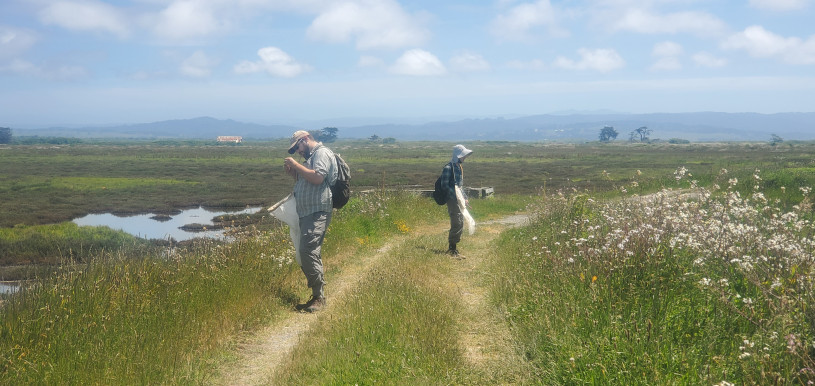
“No matter how you slice and dice it, there are a tremendous number of insect species in California,” says Dr. Megan Barkdull, Entomology Curator at NHM, and co-author on the paper. “The rate we're identifying new species with this data is nowhere near leveling off. Even with all the work that we did through the California Insect Barcode Initiative, we're not anywhere close to having collected them all.”
“We've been all over the state using every collecting method in the book, and our efforts have resulted in one of the largest insect biodiversity datasets ever put together,” says first author, Dr. Austin Baker, Senior Research Scientist at BioKEA and former Post-doctoral Fellow leading the California Insect Barcode Initiative at NHM. Insects were collected in the field and sent to labs, where chemicals were applied to the samples to break down the insect cells to extract DNA. CIBI project researchers linked specific DNA sequences to their representative insect species, building a digital library of unique codes that can identify a known insect species and determine whether they may belong to species entirely unknown to science.
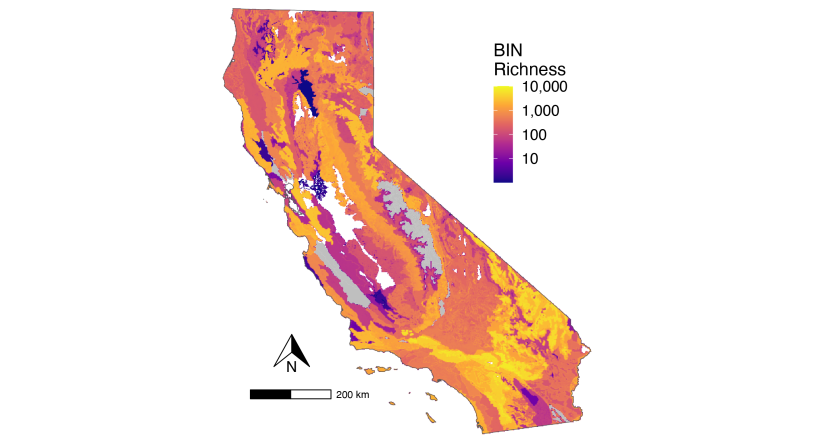
Ecoregions
To build the library, researchers collected tissue samples from museum collections like NHM’s. They also set Malaise traps in 72 ecoregions statewide and undertook dedicated expeditions to 454 additional locations across California. Malaise traps passively capture insects, but their maintenance requires active labor.
“This is an example of community science. Volunteers stepped forward to help with sampling by managing traps, which we would not have been able to do for continuous weekly sampling,” says co-author and NHM Entomology collections manager Giar-Ann Kung. Along with Baker, researchers from all over the state, and an army of volunteers, Kung set Malaise traps and collected throughout the state to capture insects. “There are people like Sara Fairchild and Michael Nance who managed a Malaise trap for over three years at a site in the high desert, which is the longest continuous site for the project. That could not have been accomplished without them.”
Ecoregions are places with similar ecosystems defined by the Environmental Protection Agency, which further subdivides them into different levels. The study looked at Level 3 ecoregions which include designations like Mojave Basin and Range, Southern California Mountains, and Sierra Nevada. The authors found that the Mojave Basin and Range had the highest insect species richness.
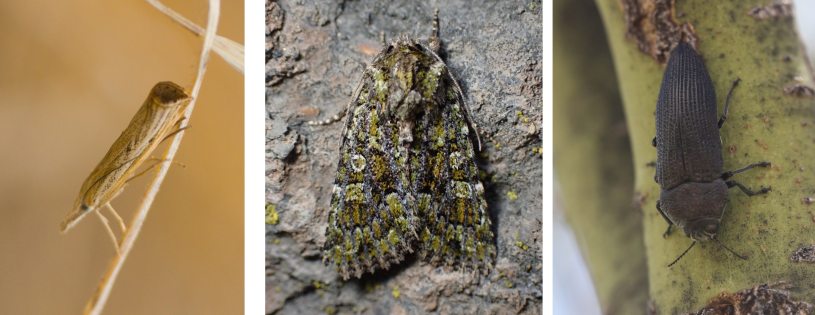
They also compared parallel ecoregions and found that each one had a unique tapestry of insect life, even if it shared a climate and geography. "The deserts are kind of more similar to each other, and the mountains in northern California are a little bit more similar to each other, but every part of the state hosts a really different insect fauna,” says Dr. Barkdull.
While there are parallels between locations that fall within the same ecoregion, the diversity at each was unparalleled. The richness of life across the state is both more abundant and more delicate than previously thought, highlighting the need for more aggressive conservation of California’s wild places.
About the Natural History Museum of Los Angeles County:
The Natural History Museum (NHM) is one of Los Angeles’ oldest cultural institutions and anchor of the evolving cultural, educational, and entertainment nexus in Exposition Park. NHM’s collection ranges from 4.5-million-year-old meteorites to newly discovered species explored throughout immersive visitor experiences such as Age of Mammals and the award-winning Dinosaur Hall. The outdoor 3.5-acre Nature Gardens and indoor Nature Lab look at people’s relationship with the environment in L.A., while another beloved permanent exhibit, Becoming Los Angeles, examines how L.A. has changed over time. NHM also features industry-leading habitat dioramas, an exquisite gem and mineral hall, a hands-on Discovery Center, and behind-the-scenes experiences such as the Dino Lab, where fossils are prepared in public view. NHM recently opened NHM Commons, a new community-focused wing designed to open new doors to natural history and celebrate the intersections of science, nature, and culture.
MEDIA CONTACTS:
Tyler Hayden
Science Communications Specialist
thayden@nhm.org
Amy Hood
Director of Communications
ahood@nhm.org